Artificial intelligence has become a powerful part of modern life. It helps people write, plan, analyze, and automate tasks that once took hours. As AI tools become more capable, it is easy to assume they can handle almost anything. Yet behind the convenience and speed, there is an important reality that often gets overlooked. Understanding AI limitations is essential if we want to use this technology wisely and responsibly.
This article explores why human judgment still matters, even in an AI driven world. It explains the limitations of artificial intelligence in simple language, helping readers understand where AI performs well and where it still depends on human thinking, values, and context.
Why Understanding AI Limitations Is Important
AI systems are designed to recognize patterns, process data, and generate outputs based on what they have learned. However, they do not truly understand meaning in the way humans do. Understanding AI limitations helps set realistic expectations and prevents blind trust in automated systems.
When people assume AI is always accurate or objective, mistakes can go unnoticed. Recognizing limitations encourages users to review, question, and apply judgment instead of accepting outputs without thought.
AI Lacks True Understanding and Awareness
One of the most fundamental AI limitations is the lack of real understanding. AI does not think, feel, or reason in the human sense. It predicts outcomes based on data patterns rather than comprehension.
This limitation becomes clear in complex situations that require nuance, empathy, or moral judgment. While AI can mimic language and logic, it does not possess awareness or intention. Human judgment is essential in interpreting and applying AI outputs correctly.
AI Limitations and Challenges with Data Dependence
AI systems rely heavily on data. The quality, accuracy, and diversity of data directly affect performance. If data is incomplete, biased, or outdated, AI results will reflect those flaws.
AI limitations and challenges become especially visible when systems are used in unfamiliar contexts. Humans, on the other hand, can adapt quickly and reason beyond past information. This ability makes human oversight crucial.
Bias and Fairness Issues in AI Systems
Bias is a well known limitation of artificial intelligence. AI models learn from historical data, which often includes human biases. These biases can appear in decision making, predictions, and recommendations.
Understanding AI limitations includes recognizing that AI does not correct bias on its own. Humans must actively identify and address fairness issues. Without human judgment, biased AI outputs can reinforce existing inequalities.
Limitations of AI in Education
In education, AI can assist with tutoring, grading, and personalized learning. However, limitations of AI in education are significant.
AI cannot fully understand student emotions, motivation, or personal struggles. Teachers play an essential role in mentoring, encouragement, and ethical guidance. AI supports learning, but human educators shape understanding and growth.
Limitations of AI in Business Decision Making
AI is widely used in business for forecasting, customer insights, and automation. Yet limitations of AI in business appear when decisions involve uncertainty, ethics, or long term vision.
AI can analyze numbers, but it cannot weigh human values, organizational culture, or social impact. Leaders must apply judgment when interpreting AI driven insights to avoid purely data driven decisions that lack context.
AI Limitations in Research and Innovation
AI accelerates research by analyzing data and identifying patterns. However, limitations of AI in research become clear when creativity, curiosity, and intuition are required.
AI cannot ask meaningful questions or explore ideas beyond existing data. Human researchers drive innovation by imagining possibilities and challenging assumptions. AI supports research, but humans guide discovery.
The Challenge of Over Reliance on AI
One growing concern is over reliance on AI systems. When users depend too heavily on automation, critical thinking skills may weaken.
Understanding AI limitations reminds us that AI should assist rather than replace judgment. Human involvement ensures accountability, ethical responsibility, and adaptability in complex situations.
What Is a Key Limitation of AI Content Generation
AI generated content is increasingly common. However, a key limitation of AI content is the lack of genuine insight and lived experience.
AI can generate text quickly, but it does not verify truth or intent. Human review is essential to ensure accuracy, originality, and ethical use. This is why responsible content creation always involves human oversight.
Limitations of the Human Mind in Artificial Intelligence Systems
While discussing AI limitations, it is also important to recognize human limitations. Humans can make emotional decisions, overlook data, or introduce bias.
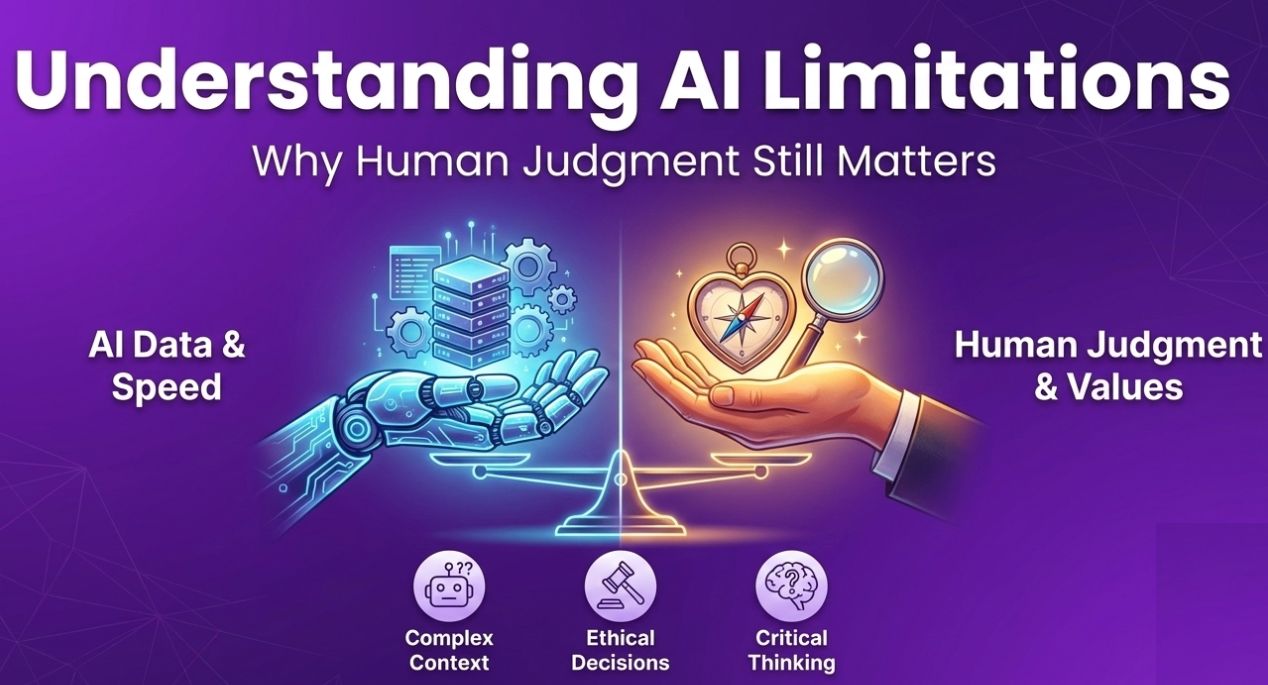
The goal is not to replace humans with AI, but to balance strengths. AI processes data efficiently, while humans provide judgment, empathy, and creativity. Understanding AI limitations helps create this balance.
AI Limitations and Challenges in Real World Contexts
Real world situations are messy and unpredictable. AI struggles when rules change or when information is incomplete.
Human judgment adapts quickly to new conditions. Understanding AI limitations means recognizing when to step in, question outputs, and make decisions that consider broader consequences.
Ethical Responsibility and Human Oversight
Ethical responsibility cannot be delegated to machines. Decisions involving people, fairness, and safety require human accountability.
Understanding AI limitations reinforces the importance of oversight. Humans must set boundaries, define values, and ensure AI systems are used responsibly across industries.
Why Human Judgment Will Always Matter
AI excels at speed and scale, but judgment involves values, experience, and context. Human judgment interprets meaning, weighs consequences, and adapts to uncertainty.
Understanding AI limitations makes it clear that AI is a tool, not an authority. Humans remain responsible for decisions, outcomes, and ethical standards.
Preparing for a Balanced AI Future
As AI continues to evolve, education about limitations becomes essential. Users who understand AI strengths and weaknesses use technology more wisely.
A balanced future involves collaboration between humans and AI. AI supports efficiency, while humans guide purpose and responsibility.
Conclusion
Understanding AI limitations is not about rejecting technology. It is about using it wisely. AI offers powerful support, but it does not replace human judgment, values, or understanding.
As AI becomes more integrated into education, business, and research, human oversight remains essential. When people recognize where AI falls short, they can use it responsibly and effectively. The future of AI is not about choosing between humans and machines, but about ensuring that human judgment continues to guide technology with care and intention.
Read More: How to Choose the Right AI Tool for Your Daily Needs in 2026