Artificial intelligence is slowly becoming part of everyday digital life. From search summaries to smart suggestions in emails and documents, AI is already shaping how people find information and make decisions. Yet, with every new advancement, one question becomes more important than ever: can we trust it?
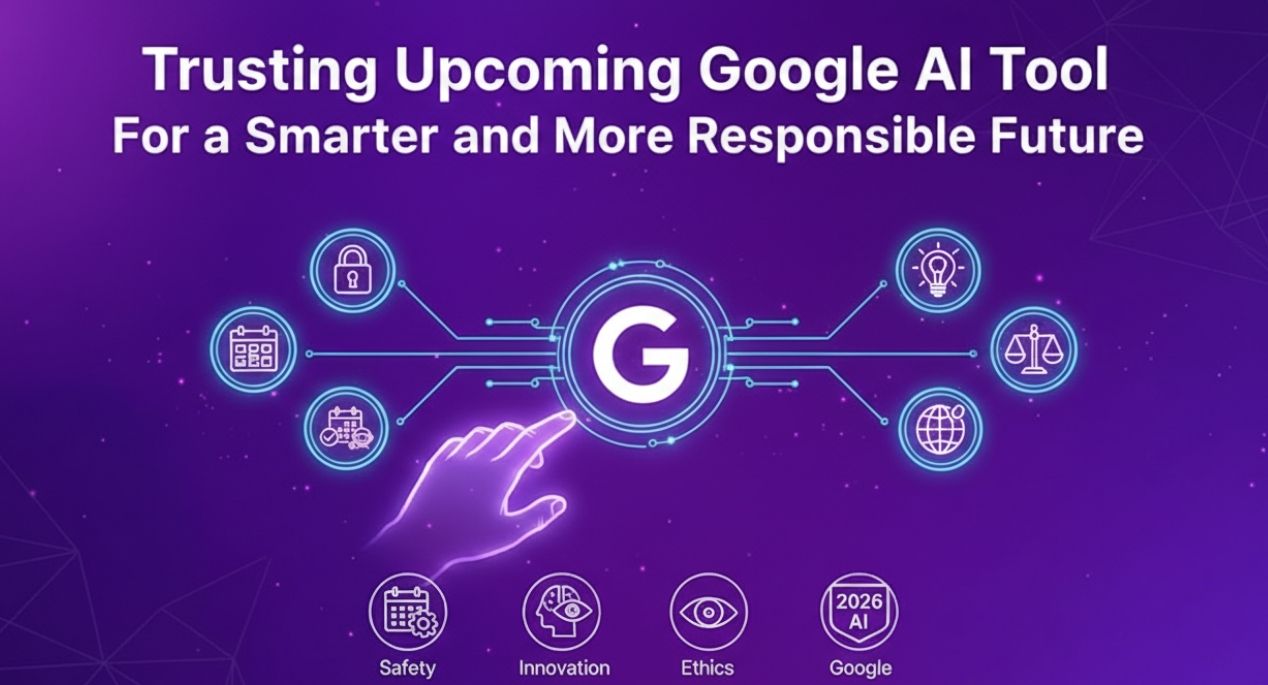
Trusting upcoming Google AI tool is not just about believing in new features or impressive demos. It is about understanding how these systems are built, what problems they aim to solve, and whether they bring real value beyond convenience. Google’s direction with AI feels different because it focuses less on novelty and more on long-term impact.
This article explores why trusting upcoming Google AI tool makes sense, how it works behind the scenes, and why it could play an important role in building a smarter and more responsible future.
Trusting Upcoming Google AI Tool
Table of Contents
What the Upcoming Google AI Tool Really Represents
The upcoming Google AI tool is not a single application or chatbot. It is a collection of specialized AI systems designed to work across real-world domains. These systems aim to interpret complex data, solve large-scale problems, and support human decision-making rather than replace it.
Trusting upcoming Google AI tool becomes easier when you see its purpose. Instead of focusing only on writing text or answering questions, Google’s AI efforts extend to climate monitoring, energy optimization, cybersecurity, and even historical research. This practical orientation sets it apart from many consumer-focused AI products.
Why Google Is Focusing on Real-World Problems
One reason people are paying attention is that Google’s AI initiatives are grounded in real challenges. Climate change, energy planning, and digital security are not abstract problems. They affect governments, businesses, and communities worldwide.
Trusting upcoming Google AI tool means recognizing this shift toward responsibility. When AI is used to track deforestation, predict energy demand, or detect cyber threats early, it becomes a support system for experts rather than a replacement for human judgment.
The People and Vision Behind Google’s AI Development
Google’s AI work is built on decades of research. While the company was founded by Larry Page and Sergey Brin, today its AI direction is shaped by research leaders and engineering teams focused on scale, safety, and reliability.
Trusting upcoming Google AI tool is closely tied to how these teams work. Instead of rushing features to market, Google emphasizes testing, validation, and ethical design. Researchers often speak openly about privacy protection, data minimization, and responsible deployment, which builds long-term confidence.
How Google’s AI Models Actually Work
At the core of the upcoming Google AI tool are advanced transformer-based models. These models are designed to understand context, relationships, and patterns across massive datasets.
Trusting upcoming Google AI tool also depends on understanding its methods. These systems combine machine learning, satellite data, language processing, and anomaly detection. The goal is not speed alone, but accuracy and relevance.
For example, when analyzing environmental data, AI compares historical trends with real-time inputs. In cybersecurity, it looks for unusual patterns rather than known threats. This adaptive approach makes AI more useful in unpredictable situations.
Using AI to Decode History and Ancient Knowledge
One fascinating application involves interpreting ancient texts. Some historical documents are too damaged or fragmented for human analysis alone.
Trusting upcoming Google AI tool becomes meaningful here. AI can compare symbols, languages, and writing patterns to reconstruct meaning lost for centuries. Instead of replacing historians, it gives them new tools to explore human history with greater depth and precision.
AI for Climate and Environmental Monitoring
Environmental monitoring is another area where Google’s AI tools stand out. Satellite imagery combined with machine learning helps track deforestation, urban expansion, and glacier movement.
Trusting upcoming Google AI tool in this context means trusting data-driven insights that help organizations respond faster. Instead of waiting months for reports, decision-makers receive early warnings that can guide action.
Supporting Smarter Energy Planning and Infrastructure
Energy systems are complex and sensitive to weather, demand, and infrastructure limits. AI models help simulate outcomes and reduce uncertainty.
Trusting upcoming Google AI tool in energy planning is about using predictions responsibly. By modeling risks and opportunities, AI supports smarter investments in renewable energy and grid stability without removing human oversight.
Cybersecurity as a Core Focus Area
Cyber threats evolve quickly, and traditional defenses often react too late. Google’s AI systems monitor patterns in network activity to detect anomalies before damage occurs.
Trusting upcoming Google AI tool in cybersecurity is important because early detection can prevent large-scale breaches. These tools support security teams by highlighting risks, not by acting independently without supervision.
How Google’s AI Differs from Competitors
Many companies focus on general-purpose AI that can do a bit of everything. Google takes a more specialized approach.
Trusting upcoming Google AI tool is easier when you see how it integrates with existing platforms like Google Search, Maps, Earth, and Cloud. Instead of standalone tools, Google builds AI into systems people already rely on, creating continuity rather than disruption.
Accessing Google’s AI Tools Today
While some tools are still upcoming, many foundations are already available. Google Cloud AI APIs, Earth Engine, and TensorFlow allow developers and researchers to experiment responsibly.
Trusting upcoming Google AI tool also means understanding that this is an evolving ecosystem. What exists today is a preview of more integrated and refined tools coming in the future.
Addressing Concerns About AI Trust and Safety
Skepticism around AI is healthy. Questions about data privacy, misuse, and over-automation are valid.
Trusting upcoming Google AI tool depends on transparency and limits. Google emphasizes privacy-aware training and controlled deployment. AI is designed to assist experts, not operate unchecked.
Why Trust Matters More Than Speed
In the race to release AI features, trust often gets overlooked. Google’s slower, research-first approach may seem less flashy, but it builds long-term reliability.
Trusting upcoming Google AI tool is about believing that AI should serve society, not overwhelm it. Responsible design matters more than quick adoption.
The Role of Humans in an AI-Supported Future
AI does not replace human values, judgment, or accountability. It amplifies human capability when used correctly.
Trusting upcoming Google AI tool means trusting a partnership model. Humans set goals, evaluate outcomes, and make decisions. AI supports with scale and analysis.
Conclusion
Trusting upcoming Google AI tool is not about blind optimism. It is about informed confidence. Google’s approach focuses on solving meaningful problems, respecting privacy, and supporting human expertise.
As AI becomes more integrated into daily life, trust will define success more than novelty. Google’s upcoming AI tools point toward a future where technology works quietly in the background, helping people understand the world better and make wiser decisions. A smarter tomorrow depends not just on powerful AI, but on AI we can trust.
Read More: How AI Is Changing the Way Students Study and Research