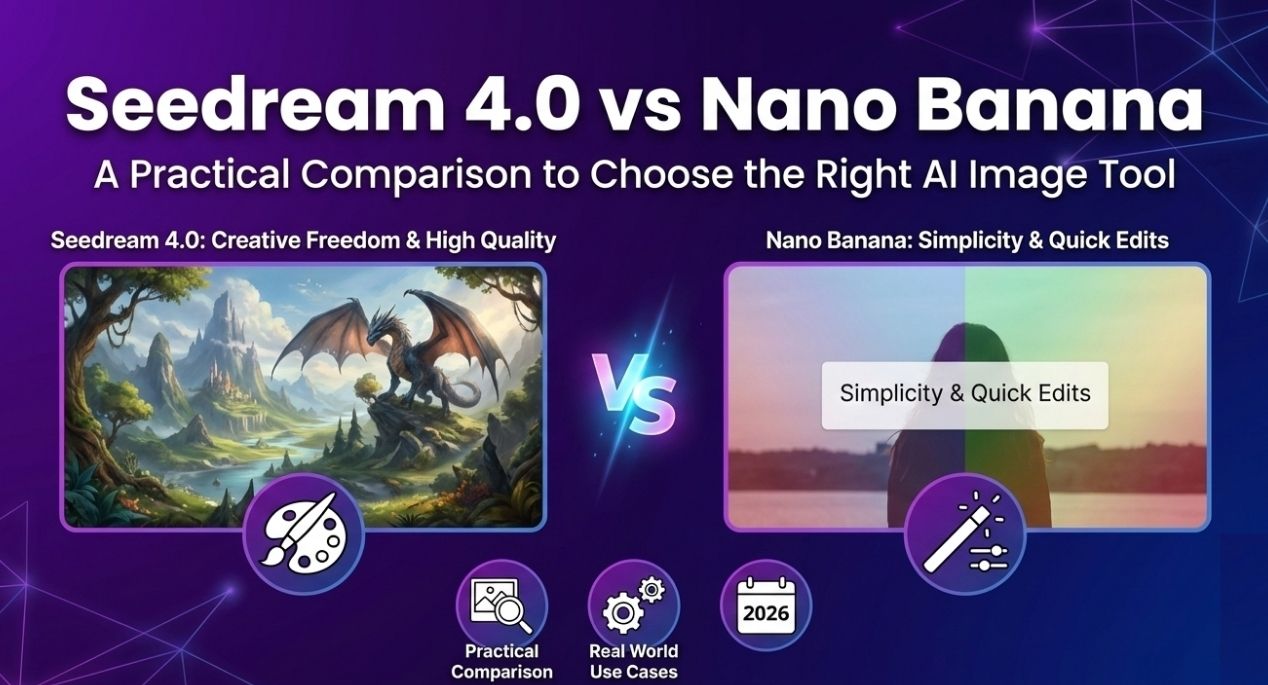
AI image generation has become much more accessible over the last year. What once required design skills or expensive software can now be done with a simple text prompt. Among the many tools available today, two names are being discussed more often than others. One is Nano Banana, known for its simplicity and quick edits. The other is Seedream 4.0, a newer tool that promises higher quality and more creative freedom.
This article looks closely at Seedream 4.0 vs Nano Banana through real world use cases. Instead of focusing on hype or technical claims, the goal here is to understand how these tools actually behave in everyday creative work. By the end, you should have a clear idea of which one fits your needs and why.
Seedream 4.0 vs Nano Banana

Table of Contents
Understanding the Core Difference Between the Two Tools
At a high level, the main difference between Seedream 4.0 vs Nano Banana is intent. Nano Banana focuses on ease of use and accessibility. It is designed for quick results without requiring any learning curve. Seedream 4.0, on the other hand, is built for users who care deeply about output quality and creative control.
Both tools generate images from text prompts, but the experience and results feel very different once you start using them consistently.
What Is Nano Banana AI and How Does It Work
Many people ask what is Nano Banana AI and why it became popular so quickly. Nano Banana is the nickname given to Google’s image generation model integrated into the Gemini app. It allows users to generate and edit images with simple instructions.
Nano Banana works well for casual tasks like social media visuals, fun edits, quick mockups, and basic product images. You do not need design experience to use it. However, the simplicity also comes with limits. Image resolution and fine details often feel basic, especially when compared to newer tools.
What Is Seedream 4.0 AI Tool and Why It Feels Different
What is Seedream 4.0 AI tool is another common question. Seedream 4.0 is an AI image generation model developed by ByteDance. It is currently available through platforms like Jimeng and focuses heavily on quality, speed, and flexibility.
Seedream generates multiple images in one prompt, maintains visual consistency, and supports high resolution outputs, including 4K. From the first use, it feels more suited for professional or serious creative work rather than casual experiments.
Seedream 4.0 vs Nano Banana Output Quality Comparison
One of the most noticeable differences in Seedream 4.0 vs Nano Banana is output quality. Nano Banana images often appear soft or slightly blurry, especially when viewed closely. Fine textures, facial details, and lighting sometimes lack clarity.
Seedream 4.0 produces sharper images by default. Details are clearer, edges are more defined, and overall composition feels more polished. For users who care about professional looking visuals, output quality alone can be a deciding factor.
Nano Banana vs Seedream 4.0 Celebrity Image Handling
Celebrity images are a sensitive area for AI tools. Nano Banana has strict limitations. It avoids generating images of real public figures or celebrities. This makes it safer but also limits creative freedom.
Seedream 4.0 does not enforce the same restrictions. Users can generate celebrity based images by name. The results are realistic and detailed, which explains why Seedream 4.0 Reddit discussions often highlight this feature. However, this freedom also means users must be more responsible to avoid misuse.
Seedream vs Nano Banana Multiple Image Generations
Another major difference in Seedream 4.0 vs Nano Banana comparison is how many images you get per prompt. Nano Banana usually generates a single image. If you want variations, you need to repeat prompts multiple times.
Seedream 4.0 generates multiple images in one request while keeping character style and quality consistent. This is especially useful for branding, storytelling, or concept exploration where consistency matters.
Comparing Style Transfer and Creative Flexibility
Style transfer tests show mixed results for both tools. Nano Banana sometimes maintains backgrounds better but struggles with precise styling. Seedream adapts characters and themes more smoothly, though it may occasionally reinterpret prompts creatively.
In most creative workflows, Seedream 4.0 feels more flexible. Designers and creators who want experimentation without losing quality will likely prefer it over Nano Banana.
Product Visuals and Branding Use Cases
When tested for product visuals and branding, the difference becomes clearer. Nano Banana may misplace logos or distort objects. It works fine for casual mockups but not for polished outputs.
Seedream 4.0 produces cleaner compositions, better alignment, and more realistic product scenes. This makes it more suitable for marketing visuals, ecommerce previews, and creative campaigns.
Virtual Outfit Try On Experience Compared
Virtual outfit try on is a growing use case. Both tools allow users to upload a person image and an outfit reference.
With Nano Banana, results are usable but often low resolution. Some outfit elements may appear incomplete. Seedream 4.0 handles this better, generating sharper images with full outfit details. This makes Seedream more reliable for fashion and lifestyle content.
Ease of Use and Learning Curve
Nano Banana is extremely beginner friendly. You can start using it immediately without understanding prompts deeply. This makes it attractive for casual users and first time AI explorers.
Seedream 4.0 requires slightly more prompt clarity, but the learning curve is still manageable. The added effort is rewarded with better results, especially for users willing to experiment.
Performance Speed and Workflow Efficiency
Speed matters when working on multiple ideas. Nano Banana generates images quickly but limits output variety. Seedream 4.0 also works fast while offering multiple results per run.
For creators working under deadlines, Seedream 4.0 often feels more efficient because it reduces repetition.
Community Feedback and Online Discussions
Searches like seedream 4.0 is nano banana reddit and Seedream 4.0 Reddit show growing interest in comparisons. Many users note that Nano Banana feels more playful, while Seedream feels more serious and production ready.
These discussions highlight a clear divide in audience rather than a simple winner.
Which Tool Is Worth Your Time
The real answer in Seedream 4.0 vs Nano Banana depends on your goals.
If you want a free, simple tool for quick edits, experiments, and casual content, Nano Banana is still useful. It is accessible and easy.
If you care about image quality, multiple outputs, creative flexibility, and professional results, Seedream 4.0 is worth your time. It fits creators, designers, marketers, and anyone who needs refined visuals.
Why This Comparison Is Trustworthy
This comparison is based on hands on testing rather than surface level features. Both tools were used across different scenarios including social graphics, product visuals, style transfers, and virtual try on tests.
The focus was on real outcomes rather than marketing claims, which makes this comparison practical and honest.
Conclusion
Seedream 4.0 vs Nano Banana is not about which tool is better in general, but which tool fits your creative needs. Nano Banana offers simplicity and accessibility. Seedream 4.0 offers quality and control.
If you are just starting out or want quick results without effort, Nano Banana is enough. If you want sharper visuals, consistent outputs, and fewer creative limits, Seedream 4.0 is the stronger choice. Understanding your use case is the key to choosing wisely.
Read More: How to Edit Images with Nano Banana A Simple Guide with 10 Creative Ideas