The internet has become a place of constant activity. Businesses, schools, governments, and individuals depend on digital systems every single day. Along with this growth, cyber threats are also becoming more advanced. Hackers no longer rely on simple tricks.
They use automation, scripts, and even artificial intelligence to attack systems. This is why emerging trends in AI cybersecurity defense are becoming so important as we move toward 2026.
Cybersecurity is no longer just about installing antivirus software or updating passwords. Today, protection depends on intelligent systems that can learn, adapt, and respond faster than humans ever could.
This article explores how AI cybersecurity defense is evolving, why it matters, and what trends are shaping digital security in 2026.
Table of Contents
Understanding Emerging Trends in AI Cybersecurity Defense
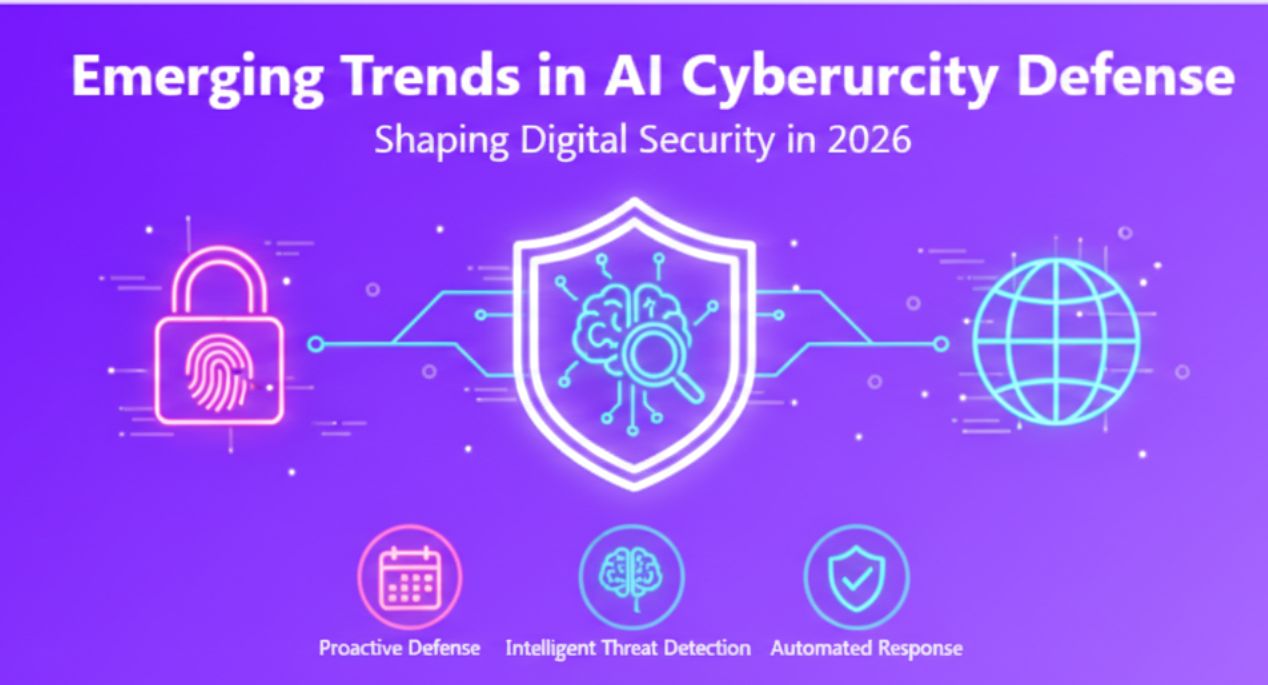
Emerging trends in AI cybersecurity defense focus on moving from reactive protection to proactive prevention. Earlier, security teams reacted after an attack happened. Now, AI systems work continuously to detect unusual behavior before damage occurs.
AI cybersecurity defense uses machine learning, deep learning, and behavioral analysis to understand what normal activity looks like inside a network. When something unusual happens, such as unexpected data access or abnormal login patterns, AI systems raise alerts or take action instantly. This shift is changing how organizations protect sensitive information.
From Manual Monitoring to Intelligent Prediction
One of the most important emerging trends in AI cybersecurity defense is predictive security. Instead of waiting for malware to activate, AI models analyze patterns and predict potential threats.
These systems study login times, device behavior, file access history, and network traffic. Even a small deviation from normal activity can signal a threat. This allows security teams to act early, reducing the chances of data breaches or ransomware attacks.
AI Cybersecurity Defense in Real-Time Threat Detection
Real-time threat detection is another key trend shaping 2026. AI systems operate 24 hours a day without fatigue. They scan massive amounts of data that would overwhelm human analysts.
With artificial intelligence in cybersecurity research paper studies showing improved detection accuracy, AI systems are now better at identifying zero-day attacks and unknown malware. This makes them especially useful in environments where new threats appear daily.
Autonomous Response and Reduced Human Dependency
A major development in emerging trends in AI cybersecurity defense is autonomous response. In the past, human approval was required to stop an attack. In 2026, AI systems are increasingly trusted to respond automatically.
When a threat is detected, AI can isolate infected devices, block suspicious IP addresses, and stop malicious processes within seconds. This reduces response time and minimizes damage. Human teams still supervise the system, but AI handles the urgent actions.
Behavioral Analysis and Insider Threat Protection
Not all cyber threats come from outside. Insider threats remain one of the hardest problems to detect. AI cybersecurity defense systems now focus heavily on behavior analysis.
By learning the normal behavior of employees, devices, and applications, AI can identify subtle misuse such as unauthorized data downloads or unusual access times. This trend is especially useful for protecting sensitive business and government data.
Cloud and Container Security Powered by AI
As organizations move to cloud platforms, security challenges grow more complex. Emerging trends in AI cybersecurity defense include stronger protection for cloud-based and containerized applications.
AI systems monitor application behavior in real time and enforce security rules automatically. They detect misconfigurations, excessive permissions, and abnormal runtime behavior. This helps prevent breaches in modern cloud environments where traditional security tools struggle.
Benefits of AI in Cyber Security
The benefits of AI in cybersecurity go beyond speed. AI reduces false alerts, improves accuracy, and allows security teams to focus on serious threats instead of routine noise.
Some key benefits include faster detection, lower operational cost, improved compliance, and continuous learning. AI systems adapt as attackers change their tactics, making defense systems more resilient over time.
Disadvantages of AI in Cybersecurity
Despite its advantages, AI cybersecurity defense is not perfect. One of the main disadvantages of AI in cybersecurity is over-reliance on automated systems. Poorly trained models can miss threats or create false positives.
There are also concerns about data privacy, transparency, and bias in AI decision making. This is why human oversight remains essential. Understanding AI limitations helps organizations use these systems responsibly.
AI Cybersecurity Certification and Skills Demand
As AI cybersecurity defense grows, demand for skilled professionals is increasing. AI cybersecurity certification programs are becoming popular among students and working professionals.
These certifications focus on understanding AI models, threat analysis, and security automation. Learning how AI works in cybersecurity helps professionals stay relevant and prepared for future challenges.
AI Cybersecurity Projects and Research Growth
AI cybersecurity projects are expanding across universities, startups, and enterprises. Research focuses on improving accuracy, reducing bias, and building explainable AI models.
Artificial intelligence in cyber security PDF studies and academic papers show continuous innovation in this field. These projects play a major role in shaping future defense strategies.
AI Cybersecurity Defense in Education and Training
Educational institutions are also adopting AI cybersecurity defense tools. These systems help protect student data and research materials while offering learning opportunities.
Limitations of AI in education are addressed through responsible deployment, teaching students ethical AI use, and combining human judgment with automation.
The Future of Emerging Trends in AI Cybersecurity Defense
Looking ahead, emerging trends in AI cybersecurity defense will focus on collaboration and resilience. AI systems will share threat intelligence securely across organizations, creating collective defense networks.
Another important trend is quantum-resistant security. AI is being used to develop encryption methods that can withstand future quantum computing threats, ensuring long-term data protection.
Human Judgment Still Matters in AI Cybersecurity Defense
Despite automation, humans remain critical in cybersecurity. AI handles speed and scale, but humans provide context, ethics, and strategic thinking.
The most successful cybersecurity strategies in 2026 will combine AI efficiency with human expertise. This partnership ensures balanced, responsible, and effective digital protection.
FAQs About Emerging Trends in AI Cybersecurity Defense
What is AI cybersecurity defense?
AI cybersecurity defense uses artificial intelligence to detect, predict, and respond to cyber threats automatically and intelligently.
Is AI reliable for cybersecurity?
AI is highly effective but works best when combined with human oversight to avoid errors and misuse.
Can beginners learn AI cybersecurity?
Yes, many AI cybersecurity certification programs and learning resources are available for beginners.
Conclusion
Emerging trends in AI cybersecurity defense show a clear shift toward smarter, faster, and more adaptive security systems. As cyber threats grow in complexity, AI becomes essential for protecting digital environments.
However, AI is not a replacement for human judgment. Its real strength lies in working alongside skilled professionals. By understanding benefits, limitations, and ethical concerns, organizations can build secure systems that are ready for 2026 and beyond.
Read More: Trusting Upcoming Google AI Tool for a Smarter and More Responsible Future