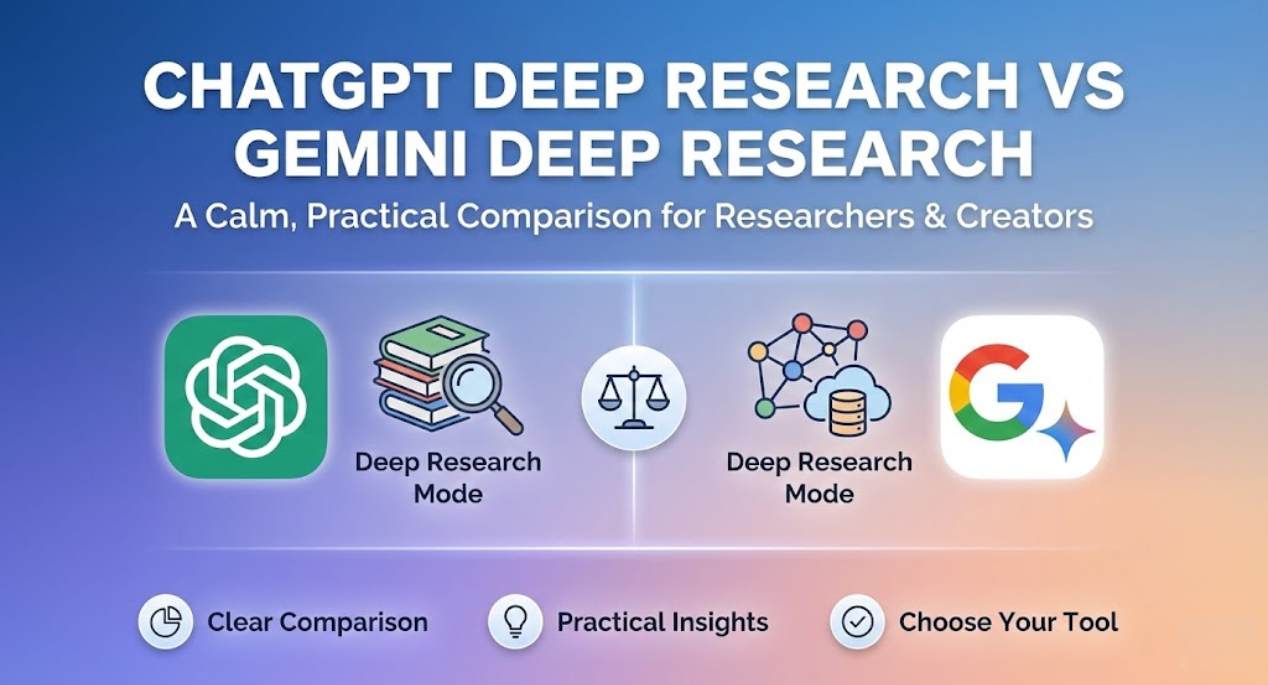
AI research assistants have moved from novelty to serious tools for anyone working with complex information. Two names come up again and again in discussions about deep research workflows: ChatGPT Deep Research from OpenAI and Gemini Deep Research from Google. Both aim to help you read, reason, and act on large amounts of information. This article compares them carefully and practically so you can choose what fits your work.
I wrote this for researchers, product teams, consultants, students, and curious creatives. No jargon heavy phrasing. Just a clear look at what each approach does well, where it struggles, and how to pick the right tool for your task.
Table of Contents
What each product tries to solve
Both ChatGPT Deep Research and Gemini Deep Research are designed to help with complex research tasks that involve long documents, cross checking facts, and building evidence based summaries.
ChatGPT Deep Research focuses on a conversational research flow. You can upload documents, ask layered questions, request citations and follow up until the answer fits your needs. It is tuned to be an assistant for iterative thinking.
Gemini Deep Research builds on Google’s strengths in search and web scale. It aims to combine deep reasoning with access to live web context and strong multimodal understanding. It leans into grounding answers in external sources while reasoning across long contexts.
Core strengths compared
ChatGPT Deep Research strengths
- Clarity of explanation and iteration. It is strong at turning a messy research brief into a structured set of next steps.
- Easy to hold a long dialogue. If your research style is conversational with many follow ups, this feels natural.
- Good for drafting reports, research memos, and annotated summaries that you will edit and publish.
Gemini Deep Research strengths
- Strong integration with web context. It is designed to use live signals and broader web knowledge in a way that makes checking sources natural.
- Multimodal reasoning. Gemini tends to handle mixed inputs like images, charts and text together more smoothly.
- Suited for workflows that need rapid grounding to web evidence or structured external data.
How they handle sources and citations
Sourcing is the most important practical difference.
ChatGPT Deep Research emphasizes cohesion and readability. It can provide citations and references but in many workflows you still need to validate the original sources. This is fine when you need polished narrative and you will verify key claims.
Gemini Deep Research places stronger emphasis on grounding. It is built with the idea that research should point to specific sources and live references so the user can verify claims quickly. If your work requires strong traceability and replicable evidence steps, this leaning matters.
Long documents and context windows
Both systems are designed to work with long contexts but they approach them differently.
ChatGPT Deep Research gives you a flexible conversational context. You can feed documents and chunk analysis into the chat. It excels at stepwise refinement where a user breaks a problem into parts and iterates.
Gemini Deep Research is engineered to reason across long context while integrating external knowledge streams. If you need broad synthesis across many sources and modalities, Gemini’s architecture often makes the synthesis feel more directly connected to the web or to uploaded media.
Multimodal capability
If your research uses images, charts, or scanned documents often, multimodal handling matters.
ChatGPT Deep Research supports multimodal inputs in its own ways and is excellent at turning text heavy material into clear narratives and outlines.
Gemini Deep Research is built with multimodal understanding deeply embedded. That is useful when research requires interpreting tables, diagrams, screenshots, and text all together.
Tooling and workflow integration
Think about where you need the research to land. Drafts, documents, data pipelines, presentations, code notebooks.
ChatGPT Deep Research integrates well with common writing workflows. It is often used to generate first drafts, to create explainers, and to prepare text that will be edited or cited.
Gemini Deep Research is positioned to connect more tightly to data and app ecosystems. If you want a research assistant that aligns with live results from search, cloud data, or other Google services, its integrations can save time.
Safety, hallucination and verification
Both systems can produce incorrect or overconfident answers. The difference is how they help you catch those issues.
ChatGPT Deep Research encourages iterative checking and allows the user to question and refine answers until the model surfaces safer conclusions.
Gemini Deep Research aims to ground outputs in external sources which can make verification faster. Still, no system is perfect and both require careful human review for critical work.
Cost and access considerations
Pricing models and quotas differ by provider and by plan. If budget matters, include the likely costs for the volume of usage you expect. Also think about data privacy and where your input is stored. Enterprise plans often offer stronger data protections and deployment options.
Where each tool is a better fit
Choose ChatGPT Deep Research if you want:
- A conversational research partner that helps structure and refine ideas quickly.
- Polished narrative drafts and research memos you will edit and publish.
- A tool for mentoring, brainstorming, and iterative deep dives.
Choose Gemini Deep Research if you want:
- Rapid grounding to live web sources and higher trust in traceability.
- Seamless handling of mixed media inputs like charts and images.
- Tight integration with web connected workflows and cloud services.
Practical example workflow for both
Imagine you need to prepare a 1500 word brief on a recent technology policy change.
With ChatGPT Deep Research you would:
- Upload the policy text and a few commentary articles.
- Ask the assistant to create an outline and a one paragraph summary.
- Use follow up questions to expand specific sections.
- Request citations and then manually verify the key references before finalizing.
With Gemini Deep Research you might:
- Ask for a summary grounded to the latest news and official sources.
- Request visual evidence such as charts or timelines extracted from the web.
- Use the assistant to surface conflicting viewpoints and link to primary sources.
- Use the result as a draft that already contains many verifiable references.
Limitations and realistic expectations
Neither system replaces expert judgment. They speed up many parts of the research cycle but they also introduce new tasks like source verification and prompt design. Expect to spend time validating claims that matter and teaching the model your style for high quality output.
Also both platforms evolve quickly. Features expand and new integrations appear. Reassess your choice as updates arrive rather than locking into a single path forever.
Choosing between them in practice
If your daily work needs quick narrative and iterative thinking, start with ChatGPT Deep Research. If you rely heavily on the web, need traceable evidence or you work across images and text, start with Gemini Deep Research.
A hybrid approach often works best. Use Gemini Deep Research to gather and ground sources and use ChatGPT Deep Research to translate that research into clear, human readable narratives.
Final thoughts
ChatGPT Deep Research and Gemini Deep Research each bring powerful strengths to modern research workflows. They reflect slightly different philosophies. One emphasizes conversation and narrative craft. The other emphasizes grounding and multimodal evidence.
Your best choice depends on the shape of your work. If you value conversational iteration go with ChatGPT Deep Research. If you want web grounding and multimodal handling go with Gemini Deep Research. For many teams the right move is to combine both where each one plays to its strengths.
Read More: Unlocking Grok Video Generator: A Simple Guide to Grok AI Text to Video Features