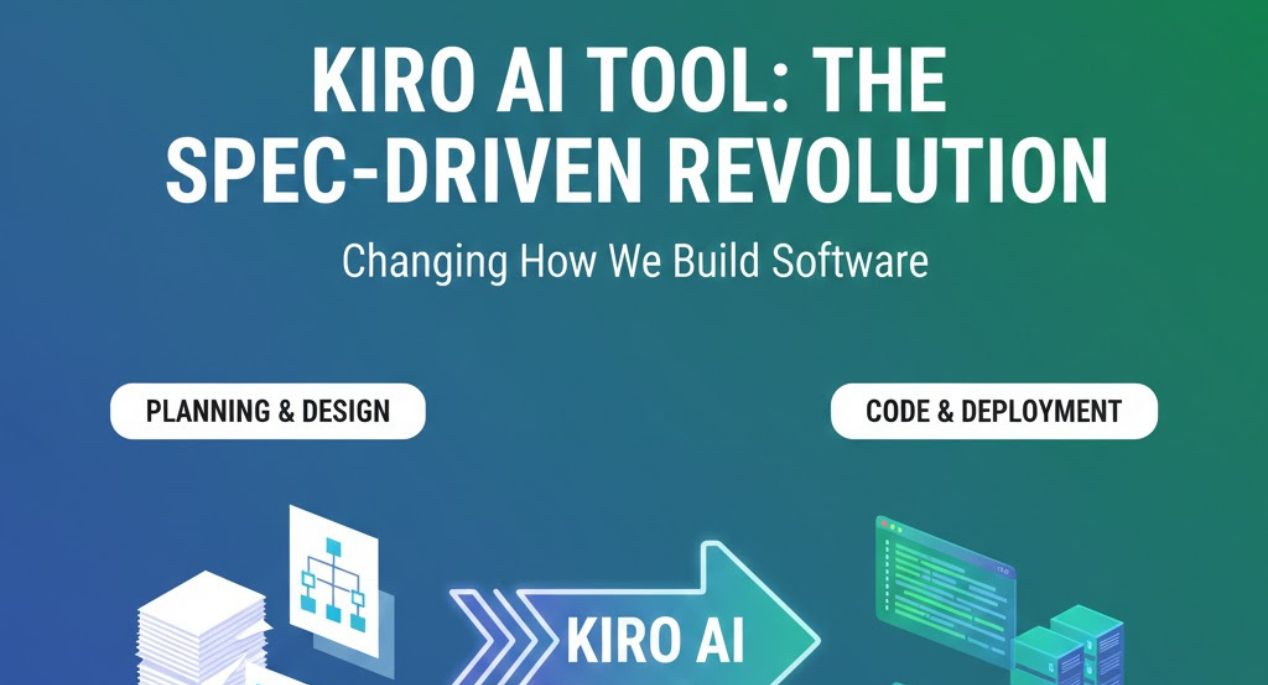
Software development is moving faster every year. New frameworks, cloud platforms, and AI assistants are helping developers build applications at incredible speed. But despite all this progress, one major problem still affects almost every development team: misalignment between planning and implementation.
Ideas live in documents. Code lives in repositories. Over time, the gap between the two becomes wider, leading to bugs, confusion, and wasted effort.
This is exactly the problem that Kiro AI Tool is designed to solve. Instead of treating specifications as static documents that are forgotten after the planning phase, Kiro makes specifications the center of development. It transforms the way teams design, build, and maintain software.
Table of Contents
What Is Kiro AI Tool and Why It Feels Different
Kiro AI Tool is an intelligent development environment built around a simple but powerful idea: software should be built directly from clearly defined specifications.
Traditional AI coding assistants focus mainly on code completion and suggestions. They help developers write code faster, but they do not fully understand the intent behind the code.
Kiro works differently. It focuses first on understanding what you want to build, why you want to build it, and what constraints or rules must be followed. Only then does it assist with implementation.
Because of this approach, Kiro is often described as a spec-driven AI IDE, meaning the specification is not just documentation but a living system that actively guides development.
This shift may sound subtle, but it changes everything about how projects are managed and scaled.
How Kiro AI IDE Works in Real Projects
In real-world development, projects usually begin with a feature description or system design document. These documents outline expected behavior, business logic, and technical boundaries.
With Kiro AI IDE, these specifications are not stored separately. Instead, they become an active part of the development workflow.
Developers define the expected behavior of a feature, and Kiro interprets that specification structurally, not just as plain text. As coding begins, the tool continuously checks whether the implementation aligns with the original intent.
If the code starts drifting away from the specification, Kiro can detect inconsistencies and provide guidance. This reduces the need for heavy debugging and prevents logic errors from spreading across the codebase.
In large projects, this type of alignment saves enormous amounts of time and improves reliability.
Why Spec-Driven Development Matters More in 2026
Software systems in 2026 are more complex than ever. Applications are built using distributed architectures, cloud services, APIs, and microservices. Teams are often remote and spread across different time zones.
In such environments, documentation becomes critical. But traditional documentation quickly becomes outdated, and outdated documentation is often worse than having none at all.
Kiro AI Tool addresses this issue by ensuring that specifications and code evolve together. When requirements change, the specification updates, and Kiro helps developers adjust the implementation accordingly.
This approach also makes onboarding new developers much easier. Instead of trying to understand thousands of lines of code without context, new team members can rely on clear specifications that explain the system’s intent.
The result is better collaboration, faster learning, and fewer misunderstandings.
Kiro AI Tool and GitHub Workflow Integration
Modern software development relies heavily on version control systems like GitHub. Any serious development tool must integrate smoothly with this workflow, and Kiro is built with this in mind.
Kiro AI Tool works alongside GitHub repositories, allowing specifications and code changes to evolve together. Every modification becomes traceable, and teams can clearly see why certain decisions were made.
This transparency improves collaboration and accountability. Developers are not just reviewing code changes; they are reviewing the reasoning behind those changes.
Over time, this creates a more structured and maintainable development culture.
Learning Curve and Tutorial Experience
One of the strengths of Kiro AI Tool is that it does not require developers to completely change how they think about coding. The interface and workflow feel natural, especially for developers who already follow structured development practices.
The tutorial experience is designed to help users understand how to write effective specifications and how to translate system requirements into clear, actionable instructions.
As developers work with Kiro, they begin to think more clearly about architecture, logic boundaries, and long-term maintainability. The tool does not just help with coding; it helps improve thinking and planning skills.
This educational aspect makes Kiro especially valuable for developers working on complex systems.
Explore More: Click Here
Amazon Kiro AI and the Importance of Trust
The connection between Kiro and the broader Amazon ecosystem adds another layer of credibility to the platform.
Amazon has a long history of building scalable and reliable infrastructure. Tools associated with this ecosystem are typically designed with performance, security, and long-term stability in mind.
Because of this, many developers see Kiro AI Tool not as a short-term experiment but as part of a larger shift in how software engineering will evolve over the next decade.
Enterprise-level security practices and strong performance standards make Kiro suitable not only for startups but also for large organizations.
Who Should Use Kiro AI Tool
Kiro AI Tool is most valuable for teams that care about long-term maintainability and architectural clarity.
Startups building scalable products can benefit from having specifications tightly connected to implementation. Enterprises managing complex systems can use Kiro to reduce technical debt and improve coordination across teams.
Even individual developers working on serious projects can benefit from the structured approach that Kiro encourages.
However, for very small scripts or quick experimental code, the advantages of spec-driven development may not be as noticeable. The real value appears when systems grow in complexity.
The Bigger Shift in Software Development
Kiro AI Tool represents a broader trend in the software industry. Development is moving away from purely code-centric workflows toward intent-centric workflows.
Instead of focusing only on writing code quickly, developers are beginning to focus on building systems correctly, with clarity and long-term sustainability.
AI tools are no longer just assistants that speed up typing. They are becoming partners that help maintain consistency, reduce errors, and improve decision-making.
Spec-driven development is likely to become a standard practice in the coming years, especially as AI becomes more deeply integrated into development environments.
Conclusion
Kiro AI Tool shows a clear direction for the future of software engineering. It is not just another AI coding assistant; it is a new way of thinking about how software should be built. By making specifications the foundation of development, Kiro helps teams maintain clarity, reduce errors, and scale systems more confidently.
Read More: Best AI Tools for Creating Instagram Reels Without Showing Your Face in 2026
Read More: Unlocking Grok Video Generator: A Simple Guide to Grok AI Text to Video Features