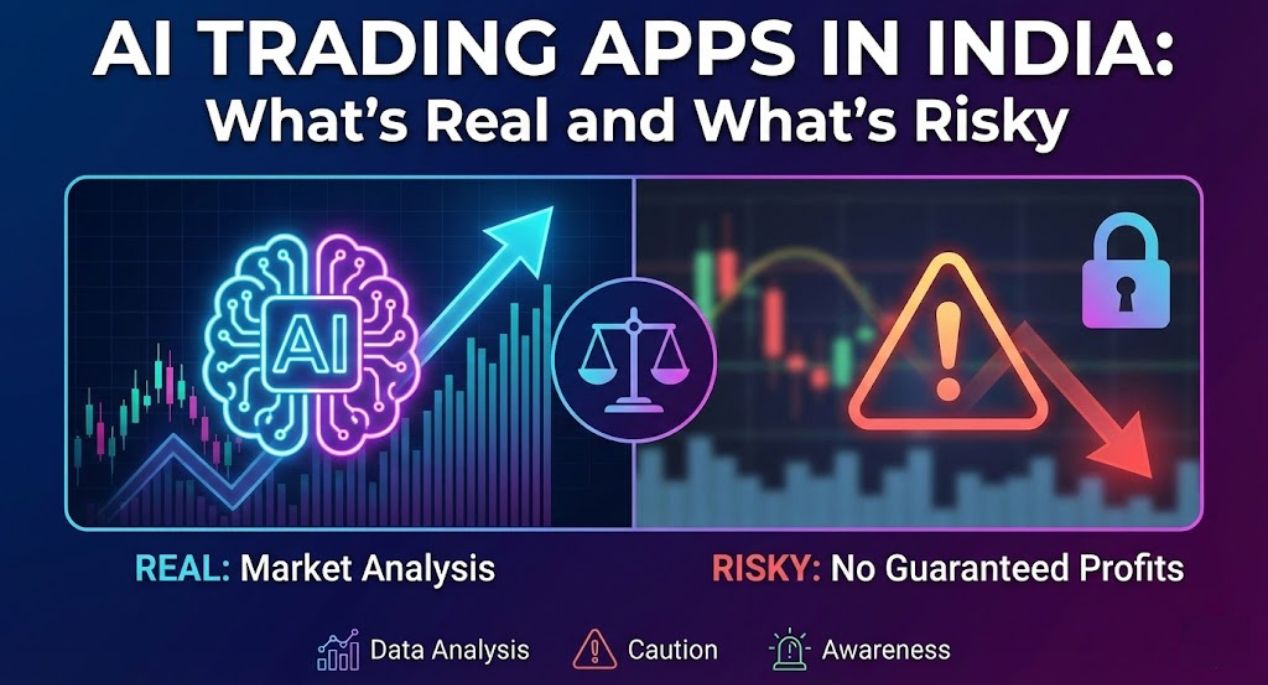
In the last two years, AI trading apps in India have become a hot topic. Many investors see ads claiming that artificial intelligence can predict stocks, find multibagger opportunities, or automate profits while you sleep. At the same time, regulators, experienced traders, and financial educators are urging caution.
The truth sits somewhere in the middle. AI is genuinely changing how market data is analyzed, but it is not a magic button for guaranteed returns. This article takes a calm, realistic look at AI trading apps in India. We will understand what is real, what is risky, and how Indian users should think about AI in trading without falling into hype.
This guide is written for awareness, not persuasion. The goal is to help you think clearly, not trade emotionally.
AI Trading Apps in India
Table of Contents
Understanding What AI Trading Apps Really Do
Most people imagine AI trading apps as systems that buy and sell stocks automatically with perfect accuracy. In reality, most AI trading apps work as decision support tools rather than decision makers.
These apps use machine learning models to analyze large amounts of data such as price movements, volume patterns, earnings reports, concall transcripts, and market sentiment. Based on this data, they generate signals, insights, or probability-based suggestions.
Some apps focus on scanning thousands of stocks to highlight unusual activity. Others summarize financial information faster than a human can. A few offer rule-based automation, but even these rely on predefined strategies, not independent intelligence.
AI does not understand markets the way humans do. It recognizes patterns from past data and applies them to new situations. When market conditions change suddenly, AI models can struggle.
What Is Real About AI Trading Apps in India
There are genuine and useful applications of AI in Indian stock markets. These benefits are real and already being used by analysts and informed retail investors.
AI is very good at processing large data sets quickly. Tasks that take humans hours or days can be completed in minutes. For example, AI can scan earnings reports across hundreds of companies and extract key insights without emotional bias.
AI also helps with consistency. Humans get tired, distracted, or influenced by news headlines. AI systems follow the same logic every time, which can be useful for screening stocks or tracking long-term patterns.
Another real advantage is time saving. Many Indian investors use AI tools to summarize concalls, track financial ratios, or identify trend changes early. These tools reduce research time but do not remove the need for judgment.
AI can also help beginners understand complex data in simpler formats. Charts, summaries, and alerts make financial information more accessible.
Where the Risks Begin
The biggest risk with AI trading apps is unrealistic expectations. Many platforms use marketing language that suggests certainty, guaranteed returns, or secret algorithms. This is where users need to slow down and think.
Markets are influenced by politics, global events, regulations, and human psychology. AI models trained on historical data cannot fully predict sudden changes. When volatility increases, models can fail.
Another risk is over-automation. Some apps encourage users to rely completely on AI-generated signals without understanding the logic behind them. This creates dependency and reduces learning.
Data quality is also a concern. If an AI model is trained on incomplete or biased data, its output will reflect those weaknesses. AI cannot judge whether the data itself is misleading.
There is also the issue of transparency. Many apps do not clearly explain how their models work, what assumptions they use, or what their limitations are.
Regulatory Perspective in India
In India, financial markets are regulated by Securities and Exchange Board of India. SEBI has repeatedly warned investors against unregistered advisory services and misleading profit claims.
AI trading apps that provide stock recommendations or automated trading features may fall under advisory or intermediary regulations. If an app is not registered or does not clearly define its role, users should be cautious.
SEBI does not ban AI in trading, but it expects transparency, compliance, and investor protection. Any platform claiming guaranteed profits is a red flag under Indian regulations.
For users, this means one simple thing. Always check whether the app positions itself as an educational tool, a data platform, or a registered advisory service.
Types of AI Trading Apps You Will See in India
Not all AI trading apps serve the same purpose. Understanding categories helps reduce confusion.
Some apps focus on stock screening. They use AI to filter stocks based on financial metrics, technical indicators, or unusual activity.
Other apps focus on research automation. These summarize concalls, extract insights from annual reports, or track news sentiment.
There are also portfolio analysis tools that use AI to highlight risk exposure, diversification issues, or performance trends.
A smaller group offers semi-automated trading strategies. These still require user approval or predefined rules and should be approached carefully.
Fully autonomous trading systems are rare and usually not suitable for retail investors.
Explore More: Click Here
How Hype Is Created Around AI Trading Apps
Hype often starts with selective success stories. An app may highlight one correct prediction while ignoring dozens of incorrect ones. Screenshots of profits without context are common.
Social media plays a big role. Influencers sometimes promote AI tools without understanding them or disclosing risks. The word AI itself creates excitement and trust, even when the tool is basic automation.
Another hype trigger is the use of complex language. Terms like neural networks or proprietary algorithms sound impressive but do not guarantee performance.
Smart investors learn to separate tool capability from marketing narrative.
How to Use AI Trading Apps Safely
The safest way to use AI trading apps is as a learning and research assistant, not a replacement for thinking.
Use AI outputs as starting points. Verify insights manually before acting. Understand why a stock is being flagged instead of blindly trusting the signal.
Avoid apps that push urgency or promise fast returns. Legitimate tools focus on process, not shortcuts.
Keep risk management in your control. Position sizing, stop-loss decisions, and long-term goals should always be human decisions.
Treat AI as a calculator, not a fortune teller.
Long Term Role of AI in Indian Markets
AI will continue to grow in Indian finance, but its role will remain supportive rather than dominant. Institutions will use AI for compliance, surveillance, and large-scale analysis. Retail investors will use it for efficiency and education.
As awareness increases, regulation will become clearer. This will likely reduce scams and improve tool quality.
The future belongs to investors who understand both technology and fundamentals, not those chasing shortcuts.
Final Thoughts
AI trading apps in India are neither miracles nor traps by default. They are tools. Used wisely, they can save time, improve analysis, and reduce emotional mistakes. Used blindly, they can increase risk and confusion.
The real advantage comes when human judgment and AI analysis work together. Awareness, patience, and understanding are still the most valuable assets in investing. If you are exploring AI trading apps, focus on learning first. Profits follow discipline, not promises.
Read More: Google Flow AI Free Explained: What It Is, How to Use It, and Real Use Cases