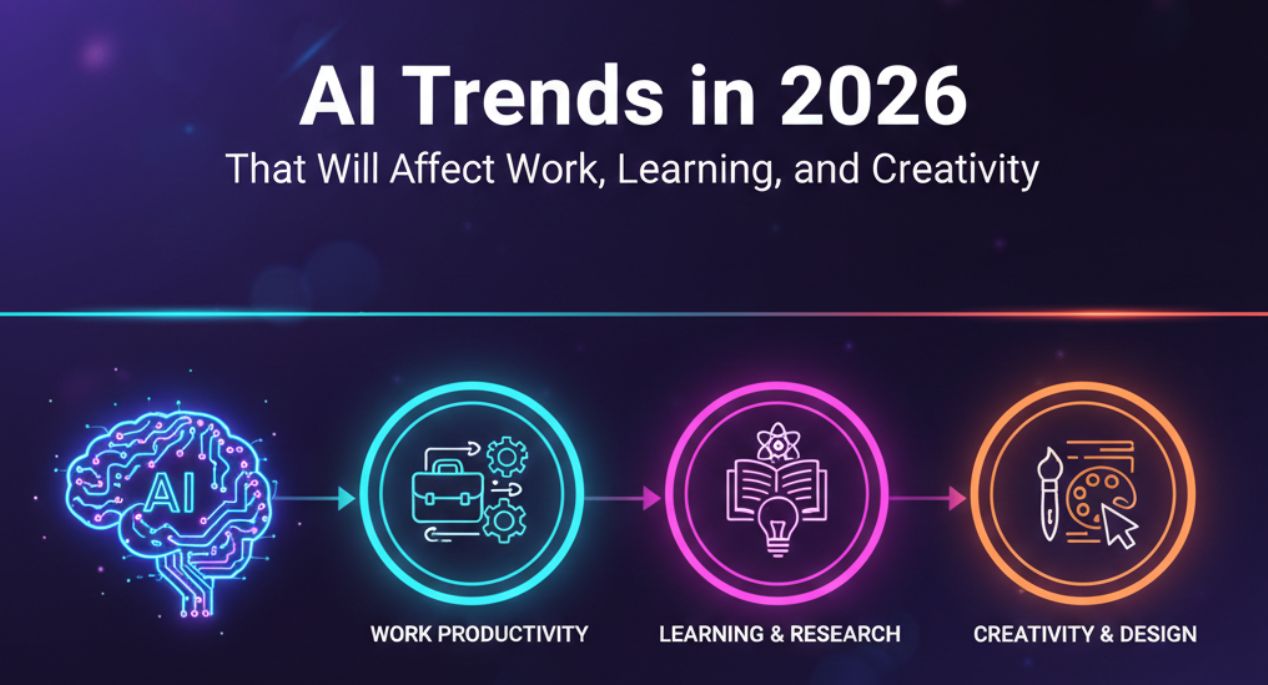
Artificial intelligence is no longer something people only read about in tech news. It is quietly becoming part of how we work, learn, and create every day. From office tools to study platforms and creative software, AI is shaping routines in ways that feel subtle but powerful.
Understanding AI trends in 2026 helps us prepare for changes that are already beginning to influence real life.
This article explores the most important AI trends in 2026 that will affect work, learning, and creativity. The focus is not on predictions that feel distant or unrealistic, but on practical shifts that people will actually experience in their daily lives.
Table of Contents
The Shift from AI Tools to AI Workflows
One of the biggest AI trends in 2026 is the move away from single-purpose tools toward connected workflows. Earlier, people used AI for one task at a time, such as writing or image generation. Now, AI systems are being designed to support entire processes.
In work environments, this means AI will help plan tasks, organize information, and follow up automatically. Instead of switching between many apps, users will rely on AI to connect everything smoothly. This trend will make work feel less fragmented and more structured.
AI Becoming a Daily Work Assistant, Not a Replacement
A common fear around AI is job replacement. However, AI trends in 2026 show a different direction. AI is increasingly designed to assist rather than replace humans.
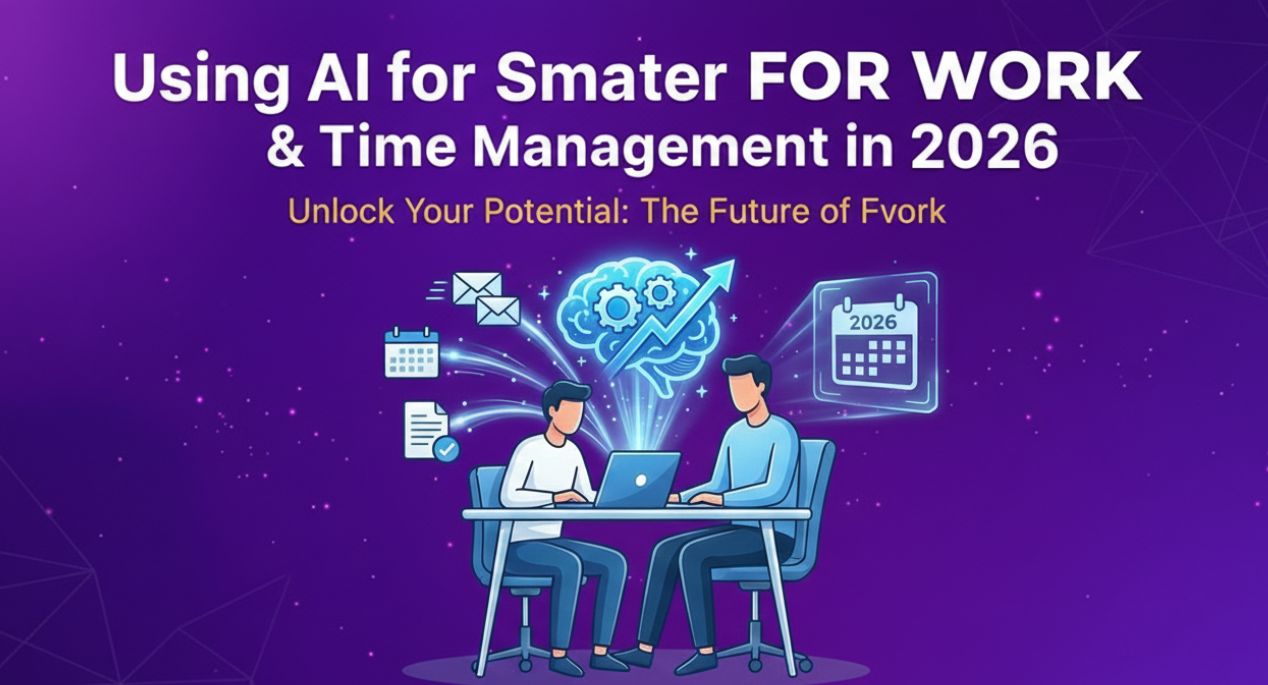
In offices and remote work setups, AI will handle repetitive tasks like scheduling, summarizing meetings, and organizing data. Human workers will focus more on decision making, communication, and creative thinking. This balance helps improve productivity without removing the human element from work.
Smarter Learning Through Personalized AI Support
Learning is changing fast, and AI trends in 2026 are making education more personalized. AI systems can now adapt learning materials based on a student’s pace, strengths, and gaps.
Instead of one-size-fits-all lessons, learners receive explanations that match their understanding level. This applies to school education, professional upskilling, and self-learning platforms. AI does not replace teachers, but it supports learners in understanding complex topics more clearly.
AI Helping Students Research More Effectively
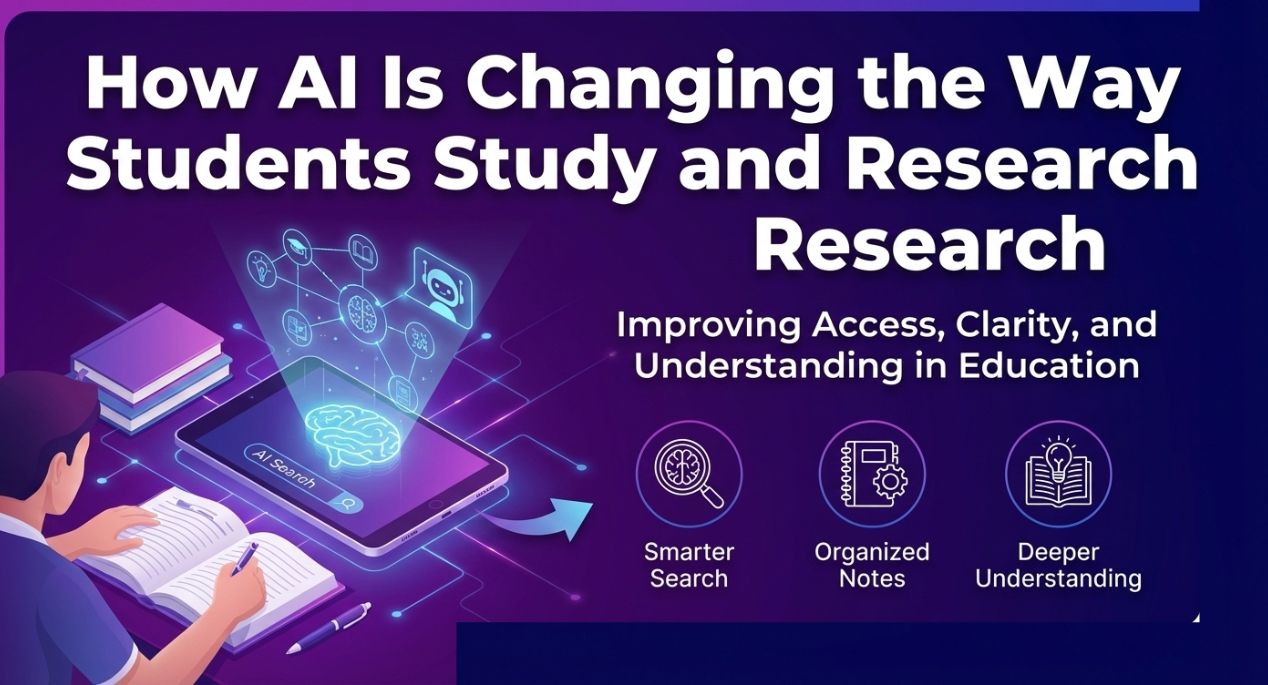
Research has always been time-consuming. One important AI trend in 2026 is AI acting as a research assistant. Students and researchers use AI to summarize articles, find patterns, and explore related topics faster.
This does not mean skipping learning. It means spending less time searching and more time understanding. AI helps reduce information overload, making research more approachable for beginners and advanced learners alike.
Creativity Supported by AI, Not Controlled by It
Creativity is often seen as a purely human skill. AI trends in 2026 show that AI is becoming a creative partner rather than a replacement.
Writers, designers, musicians, and video creators use AI to explore ideas, generate drafts, and experiment with styles. Humans still guide the creative direction. AI simply helps remove creative blocks and speeds up exploration.
The Rise of Multimodal AI Experiences
Another important AI trend in 2026 is multimodal interaction. AI systems are now better at understanding text, images, audio, and video together.
This means users can speak, show images, upload documents, and receive more accurate responses. For work, this improves collaboration. For learning, it makes education more engaging. For creativity, it opens new ways to express ideas across formats.
AI Improving Focus and Reducing Digital Overload
Modern work and learning environments suffer from constant distraction. AI trends in 2026 include tools that help manage attention.
AI analyzes work patterns and suggests focused work sessions, breaks, and priority tasks. Instead of pushing people to work longer, AI encourages smarter use of time. This supports mental well-being along with productivity.
Ethical and Responsible AI Becoming a Priority
As AI becomes more powerful, responsibility becomes more important. AI trends in 2026 show stronger focus on ethics, transparency, and privacy.
Users are becoming more aware of how AI systems use data. Companies are responding by building clearer guidelines and controls. Responsible AI design builds trust and ensures long-term adoption without fear or misuse.
AI Skills Becoming Essential for Careers
Another key AI trend in 2026 is the growing importance of AI literacy. People do not need to become programmers, but understanding how to work with AI is becoming a core skill.
Professionals who know how to guide AI, review outputs, and apply results thoughtfully will have an advantage. Learning how to collaborate with AI becomes part of career growth across industries.
AI Supporting Remote and Hybrid Work Models
Remote work is now a permanent part of many industries. AI trends in 2026 show AI playing a major role in supporting distributed teams.
AI helps coordinate schedules, summarize discussions, and track progress across time zones. This reduces communication gaps and keeps teams aligned without micromanagement.
AI Enhancing Decision Making with Better Insights
Data driven decisions are becoming easier with AI. AI trends in 2026 include systems that analyze large datasets and present insights in simple language.
Managers and professionals can understand patterns without deep technical knowledge. Human judgment still guides final decisions, but AI provides clarity and context.
The Balance Between Automation and Human Control
Automation continues to grow, but AI trends in 2026 emphasize balance. Complete automation is rarely ideal.
The most effective systems allow humans to stay in control while AI handles routine work. This partnership ensures accountability, creativity, and adaptability remain human strengths.
Creativity in Education and Work Using AI
Creative thinking is becoming more valuable as routine tasks get automated. AI trends in 2026 support creativity by freeing time and mental space.
In education, students use AI to explore ideas and experiment. In work, teams brainstorm faster and test concepts quickly. Creativity becomes more accessible, not limited to specialists.
Preparing for a Future Shaped by AI
Preparing for AI trends in 2026 does not require drastic change. It requires curiosity and openness.
People who start small, learn gradually, and use AI responsibly will adapt easily. The goal is not to chase every new tool, but to understand how AI fits into personal and professional goals.
Conclusion
AI trends in 2026 show a future where technology supports work, learning, and creativity without replacing human values. AI becomes a quiet helper, improving clarity, saving time, and opening new possibilities.
The most important change is not technical, but cultural. Learning how to work with AI thoughtfully will shape success in the coming years. Those who embrace balance, responsibility, and curiosity will benefit most from the AI-powered world ahead.
Read More: AI Agents vs AI Tools: What’s the Difference and Why It Matters in 2025