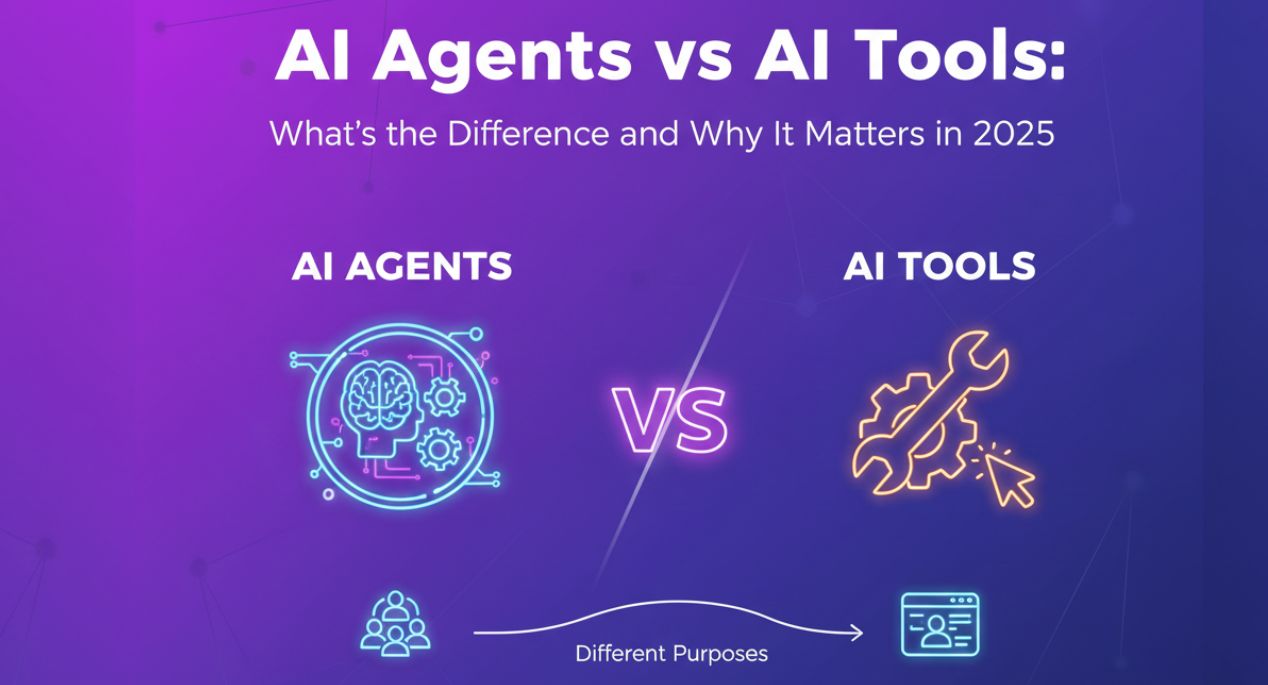
Artificial intelligence is no longer limited to simple chatbots or single-task software. In 2025, the AI landscape is evolving into something more layered and more powerful. Two terms now appear frequently in conversations about productivity, automation, and future work: AI agents and AI tools. While they sound similar, they serve very different purposes.
Understanding AI agents vs AI tools helps people choose the right technology for their needs. Whether you are a student, professional, creator, or business owner, knowing the difference can save time, reduce confusion, and lead to better results. This article explains these concepts clearly, without technical overload, and shows why the distinction matters more than ever.
Table of Contents
Understanding the Basic Idea Behind AI Tools
AI tools are designed to perform specific tasks. They respond to direct instructions and help users complete work faster or more easily. Examples include writing assistants, image generators, note summarizers, and data analysis tools.
In the context of AI agents vs AI tools, tools are reactive. They wait for input, perform a function, and then stop. They do not make decisions on their own. This makes them predictable, controlled, and easy to use.
Most people already use AI tools daily, often without realizing it. Spell checkers, recommendation systems, and voice assistants fall into this category.
What Makes AI Agents Different from AI Tools
AI agents go beyond single tasks. Instead of only responding to commands, they can plan actions, make decisions, and work across multiple steps to achieve a goal.
When comparing AI agents vs AI tools, agents are proactive. They can decide what to do next based on context. For example, an AI agent might analyze your schedule, notice an upcoming deadline, gather resources, draft content, and suggest next steps without being asked at every stage.
This autonomy is what makes AI agents powerful, but also more complex.
AI Assistant vs AI Agent vs Agentic AI Explained Simply
Many people get confused by terms like AI assistant, AI agent, and agentic AI. An AI assistant is usually a tool that responds conversationally. It helps answer questions or complete tasks when prompted.
An AI agent operates with a goal in mind. It may use multiple tools, make decisions, and adapt its behavior. Agentic AI refers to systems designed specifically to act independently toward objectives.
Understanding this distinction clarifies AI agents vs AI tools and explains why agents feel more like collaborators than utilities.
AI Agents vs AI Tools Examples in Real Life
Real life examples help make the difference clear. A writing tool that generates a paragraph when asked is an AI tool. An AI system that plans a content calendar, drafts posts, schedules publishing, and tracks performance is an AI agent.
In customer support, a chatbot answering questions is a tool. A system that routes tickets, prioritizes issues, follows up with users, and reports trends is an agent.
These AI agents vs AI tools examples in real life show how agents handle workflows, while tools handle tasks.
Chatbots vs AI Assistant vs AI Agent
Chatbots are often rule-based or lightly AI-powered. They follow scripts and handle simple conversations. AI assistants improve on this by understanding language better and offering more flexible responses.
AI agents take it further by acting across systems. They can integrate calendars, databases, and software tools to complete complex goals. This progression highlights the evolution behind AI agents vs AI tools.
AI Agent Examples Across Different Industries
AI agent examples are becoming more common in business and research. In finance, agents monitor markets and adjust strategies. In education, they personalize learning paths. In software development, they test code, deploy updates, and monitor performance.
These systems demonstrate how agents operate continuously rather than waiting for input. This capability separates them clearly from traditional AI tools.
AI Agent vs ChatGPT Style Tools
Many users compare AI agent vs ChatGPT because ChatGPT feels advanced. However, ChatGPT on its own is still a tool. It responds to prompts but does not act independently.
When ChatGPT is connected to planning systems, memory, and external tools, it can become part of an agent. This distinction is central to understanding AI agents vs AI tools in practical use.
The Role of Prompts in AI Assistants and AI Agents
Prompts play a different role in each system. AI tools rely heavily on prompts. Clear instructions lead to better results.
AI agents use prompts as starting points, but they do not depend on constant input. Once given a goal, they decide how to proceed. This reduces repetitive prompting and allows more fluid workflows.
This difference changes how people interact with technology daily.
Control and Responsibility Differences
AI tools give users full control. Nothing happens unless a command is given. This makes them safer and easier to manage.
AI agents require oversight. Because they act autonomously, users must define boundaries, rules, and permissions. Understanding AI agents vs AI tools helps prevent misuse and unexpected outcomes.
Responsibility remains with humans, especially when agents affect real-world systems.
Why This Difference Matters for Productivity
For simple tasks, AI tools are often enough. Writing emails, summarizing notes, or generating images does not require autonomy.
For complex workflows, AI agents shine. They reduce coordination effort and handle multiple steps smoothly. Choosing the right approach improves efficiency without adding complexity.
This is why understanding AI agents vs AI tools matters for anyone planning long-term productivity strategies.
AI Agents vs AI Tools in the Workplace
In workplaces, AI tools assist employees. AI agents reshape processes. Tools help individuals. Agents help systems.
For example, a reporting tool generates charts. An agent collects data, analyzes trends, prepares reports, and alerts managers. This distinction affects hiring, training, and workflow design.
Risks and Limitations of AI Agents
While powerful, AI agents come with risks. Autonomy increases the chance of errors, bias, or unintended actions.
AI tools are easier to audit because their actions are limited. Agents require careful monitoring. Understanding AI agents vs AI tools helps organizations adopt them responsibly.
Choosing Between an AI Tool and an AI Agent
The choice depends on goals. If you want help with one task, choose a tool. If you want a system to manage a process, consider an agent.
Beginners should start with AI tools to understand limitations and strengths. Agents are better introduced gradually as experience grows.
The Future of AI Agents vs AI Tools
In the future, the line may blur. Tools will gain more autonomy, and agents will become easier to control.
Still, the distinction will remain important. Understanding AI agents vs AI tools will help people navigate new technologies confidently rather than feeling overwhelmed.
Conclusion
AI agents vs AI tools represent two different ways of using artificial intelligence. Tools respond. Agents act. Both have value, but they solve different problems.
As AI becomes more integrated into daily life and work, knowing the difference helps people choose wisely. Tools support tasks. Agents support goals. When used responsibly, both can improve productivity, creativity, and efficiency without replacing human judgment.
Read More: 15 AI Tools That Are Quietly Becoming Part of Everyday Work and Learning