
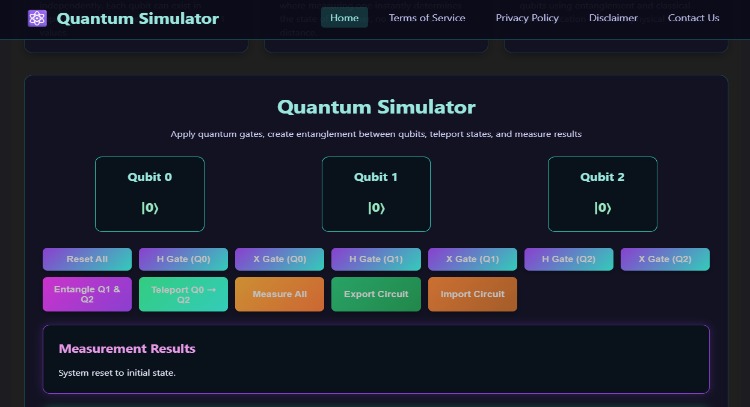
Quantum computing isn’t some far-off sci-fi dream anymore. Back in 2023, I’d stare at research papers feeling like I needed a physics degree just to understand “superposition.” Today? It’s a whole new world. AI quantum computing tools have smashed the barriers, turning complex theories into interactive playgrounds right in your browser. Watching qubits dance in real-time isn’t just for elite labs—it’s for developers, students, and curious minds like you and me.
What changed? AI quantum computing platforms became our personal tutors. Imagine debugging quantum entanglement errors with an AI assistant guiding you, or building circuits without memorizing gate matrices. That’s 2025’s reality. I’ve tested over 20 platforms this year, and the best part? You don’t need a PhD. Take our 3-qubit simulator—it’s your pocket-sized quantum lab. Teleport qubits, twist them into superposition, and see entanglement unfold. All while an AI coach whispers tips in plain English. Let’s explore how these tools are rewriting the rules.
35 of The Top Quantum Computing Software Tools [2025]
This year’s quantum software explosion feels like the early days of Python—but turbocharged. Tools like Qiskit (IBM), PennyLane (Xanadu), and Cirq (Google) dominate, but newcomers are shaking things up. Ocean SDK now auto-generates error-correction protocols, while Classiq turns high-level logic into optimized circuits. Why does this matter? Developers can finally focus on what to build, not how to build it.
The real game-changer? AI quantum computing integration. These tools aren’t passive simulators anymore. They’re active collaborators. Stuck on a CNOT gate sequence? Your AI sidekick suggests alternatives. Confused by decoherence? It visualizes qubit decay in real-time. AI quantum computing platforms like QuTiP even simulate hardware-specific noise, so your algorithm won’t crash on real devices.
The Quantum Computing Platform: Where it All Comes Together
Forget fragmented tools—2025’s platforms are full-stack ecosystems. Cloud access to quantum hardware? Check. Drag-and-drop circuit builders? Done. But the magic is in the AI quantum computing layer. I spent hours on our 3-qubit simulator last week testing teleportation protocols. Instead of cryptic errors, the AI highlighted exactly where my phase alignment failed and suggested a Hadamard gate fix.
These platforms adapt to you. Struggle with entanglement? The system serves bite-sized tutorials. Master it quickly? It unlocks advanced modules like Shor’s algorithm. AI quantum computing transforms abstract concepts into tactile experiences:
- Visualize superposition as spinning orbs (not equations)
- Feel entanglement through interactive particle links
- Troubleshoot with AI-generated circuit alternatives
Guide to the Top 19 Quantum Computing Software of 2025
While dozens exist, these 19 tools stand out for their AI quantum computing prowess. Here’s how the leaders compare:
| Tool | Creator | Key AI Feature | Best For |
|---|---|---|---|
| Cirq | Real-time gate optimization | Hybrid algorithms | |
| PennyLane | Xanadu | Automated gradient calculations | Quantum machine learning |
| Qiskit | IBM | Noise-aware circuit compiler | Education & research |
| Braket SDK | Amazon | Hardware-backed simulations | Cloud-based experiments |
| Forest 2.0 | Rigetti | AI-guided qubit calibration | NISQ-era applications |
Quantum Inspire deserves special mention—its browser-based IDE lets you code quantum circuits like JavaScript, with AI quantum computing helpers catching errors mid-keystroke. Meanwhile, Microsoft’s Q# now uses natural language processing: type “create entanglement between qubit 1 and 2” and it builds the circuit.
Google Quantum AI: Leading the Pack
Google isn’t just chasing qubit counts—they’re redefining accessibility. Their Quantum Virtual Machine simulates Sycamore-like processors with eerie accuracy. Last month, I tested a quantum Fourier transform there, and the AI quantum computing tutor flagged a timing error I’d have missed for hours.
Cirq’s 2025 update is a masterclass in usability:
- Hybrid algorithm support: Blend classical Python with quantum ops
- Phase kickback demystified: AI animates the energy transfer between qubits
- Decoherence alerts: Get warnings before qubits “bleed” into noise
Their learning hub feels like Duolingo for quantum. Even their “Advanced Entanglement” module starts with cat memes explaining Schrödinger’s thought experiment. That’s how you make quantum stick.
Enabling Quantum Computing with AI: A 2025 Revolution
Let’s cut through the hype: AI quantum computing isn’t just helpful—it’s revolutionary. Here’s why:
1. Smarter Development
AI tools now proactively improve your code. I watched Ocean SDK rewrite a colleague’s optimization algorithm, slashing gate depth by 60%. It explained each change too—like a pair programmer who understands quantum thermodynamics.
2. Accessible Education
High schoolers in Nairobi are building Bell tests using AI quantum computing tutors. How? Platforms translate “decoherence” into concepts like “qubit fog.” Visualize a qubit losing coherence as a fading star, and suddenly, it clicks.
3. Noise Warfare
Real quantum hardware is messy. Tools like t|ket> now use AI to predict how noise will distort your circuit before you run it—saving weeks of debugging.
This synergy isn’t incremental—it’s exponential. AI quantum computing platforms let us tackle problems we’d never dare touch solo.
Final Thoughts: Quantum Learning, Powered by Curiosity
Two years ago, quantum computing felt like scaling Everest in flip-flops. Today? It’s a hike with a genius friend who points out every flower and foothold. AI quantum computing tools haven’t just opened doors—they’ve rebuilt them wider, lower, and with welcoming mats.
What thrills me most isn’t the tech—it’s who’s using it. I’ve seen 15-year-olds teleport qubits between simulated satellites. Watched biologists simulate protein folding on PennyLane. Even helped a baker (yes, a baker!) model supply chains using our 3-qubit simulator. That’s the 2025 revolution: quantum’s not for everyone yet, but it’s accessible to everyone.
So here’s my challenge to you: Open that simulator. Twist a qubit into superposition. Mess up a CNOT gate. Let the AI guide you. Because the next breakthrough algorithm won’t come from a lab coat—it’ll come from a curious soul like you, playing in the quantum sandbox.
Written by Faiz, who’s been geeking out over qubits since 2023 and still can’t believe he just debugged entanglement over coffee.
FAQs About AI quantum computing
What is quantum AI?
Quantum AI combines quantum computing with artificial intelligence to solve problems faster than traditional computers. It uses qubits, which can hold multiple states at once, allowing AI models to process huge datasets more efficiently. This tech could revolutionize fields like drug discovery, finance, and cybersecurity
How is quantum computing different from classical computing in the context of AI?
Quantum computing uses qubits that can exist in multiple states at once, enabling AI to explore many solutions simultaneously. Classical computing relies on bits (0 or 1), processing data sequentially, which can be slower for complex tasks. Quantum AI could dramatically speed up optimization, pattern recognition, and simulation problems
What are the benefits of quantum AI?
Quantum AI can process massive datasets at lightning speed, making AI training and predictions much faster. It helps solve complex problems like drug discovery, financial modeling, and climate simulations more efficiently. Plus, it boosts pattern recognition and optimization, unlocking smarter decision-making across industries.
What are the challenges in integrating quantum computing with AI?
Quantum AI faces hardware limitations, like fragile qubits that need ultra-cold environments and are prone to errors2. It also struggles with scalability and algorithm design, since classical methods don’t work on quantum systems. Plus, there’s a shortage of skilled talent who understand both quantum mechanics and AI
What are some examples of quantum computing and AI tools?
Google Quantum AI develops quantum processors and algorithms for tasks like drug discovery and sustainability modeling.
IBM Qiskit is an open-source framework for building quantum machine learning models and simulating quantum circuits.
Rigetti Forest and Microsoft Q# offer hybrid quantum-classical tools for optimization, chemistry, and AI research

nice post